
Pfister House Colmar Architectural Details Guide
Explore the Pfister House Colmar architectural details. Discover this 1537 Renaissance gem in our 2025 guide. Learn about the murals and history today!
On this page
Colmar is a dream for lovers of old world charm and historic European design. One specific building captures every visitor's attention immediately upon arrival in the city center. We are talking about the incredible Pfister House Colmar architectural details seen on its facade. This structure represents the height of the German Renaissance style in the Alsace region.
The house stands at a busy intersection in the heart of the old town district. It serves as a reminder of the wealth found in Colmar during the sixteenth century. Many tourists stop here to admire the intricate paintings and unique wooden features. It is arguably the most famous private residence in this part of France today.
Understanding the design of this building requires looking closely at its many complex layers. Each level of the house tells a different story about the person who built it. You will see religious symbols mixed with political messages from the Holy Roman Empire. This guide explores every fascinating aspect of this architectural masterpiece in Colmar.
Origins and History of Maison Pfister
The Pfister House dates back to 1537 and remains remarkably well preserved for its age. A wealthy hatter named Ludwig Scherer commissioned the construction of this grand family home. He wanted to showcase his high social status through bold and expensive design choices. You can find more context in our historic buildings Colmar guide for your trip.
The building eventually took its current name from the Pfister family during the nineteenth century. They purchased the property in 1841 and began a series of vital restoration projects. Their efforts saved the historic murals and wooden galleries from falling into total decay. Today the building stands as a testament to their dedication to local heritage.
Maison Pfister is unique because it blends medieval traditions with modern Renaissance innovations. While the ground floor uses traditional stone, the upper levels feature elaborate decorative elements. This transition marks the shifting tastes of the wealthy merchant class in early modern Europe. It remains one of the finest examples of domestic architecture from this specific era.
Most visitors are surprised to learn that the house was originally a private residence. It was not a public building or a government office despite its very grand appearance. Scherer used the ground floor for his business while living in the upper stories. This layout was common for successful craftsmen living in busy European trading cities.
Pfister House Colmar Architectural Details: The Murals
The most striking Pfister House Colmar architectural details are the vibrant murals covering the facade. These paintings were created by a talented artist to reflect the owner's deep religious faith. You will see scenes from the Old Testament displayed prominently on the exterior walls. These images would have been recognizable to every citizen walking past the house.
The murals also feature depictions of various Germanic emperors from the Holy Roman Empire. This choice demonstrated the owner's loyalty to the political powers of the sixteenth century. Portraits of the four Evangelists appear alongside these imperial figures on the corner turret. These details make the house look like a giant illustrated book for the public.
The colors of the murals remain surprisingly vivid despite centuries of exposure to the elements. Specialized conservators use traditional techniques to clean and repair the pigments every few decades. This careful maintenance ensures that future generations can enjoy the beauty of the Renaissance artwork. The paintings cover almost every square inch of the upper stone surfaces.
If you take a Colmar architecture walking tour, you will learn about the techniques used here. The artist applied paint directly onto wet plaster to ensure the colors lasted for many years. This method is known as fresco painting and requires great skill and speed. It was a very expensive way to decorate a private home at the time.
The Stunning Corner Tower and Wooden Gallery
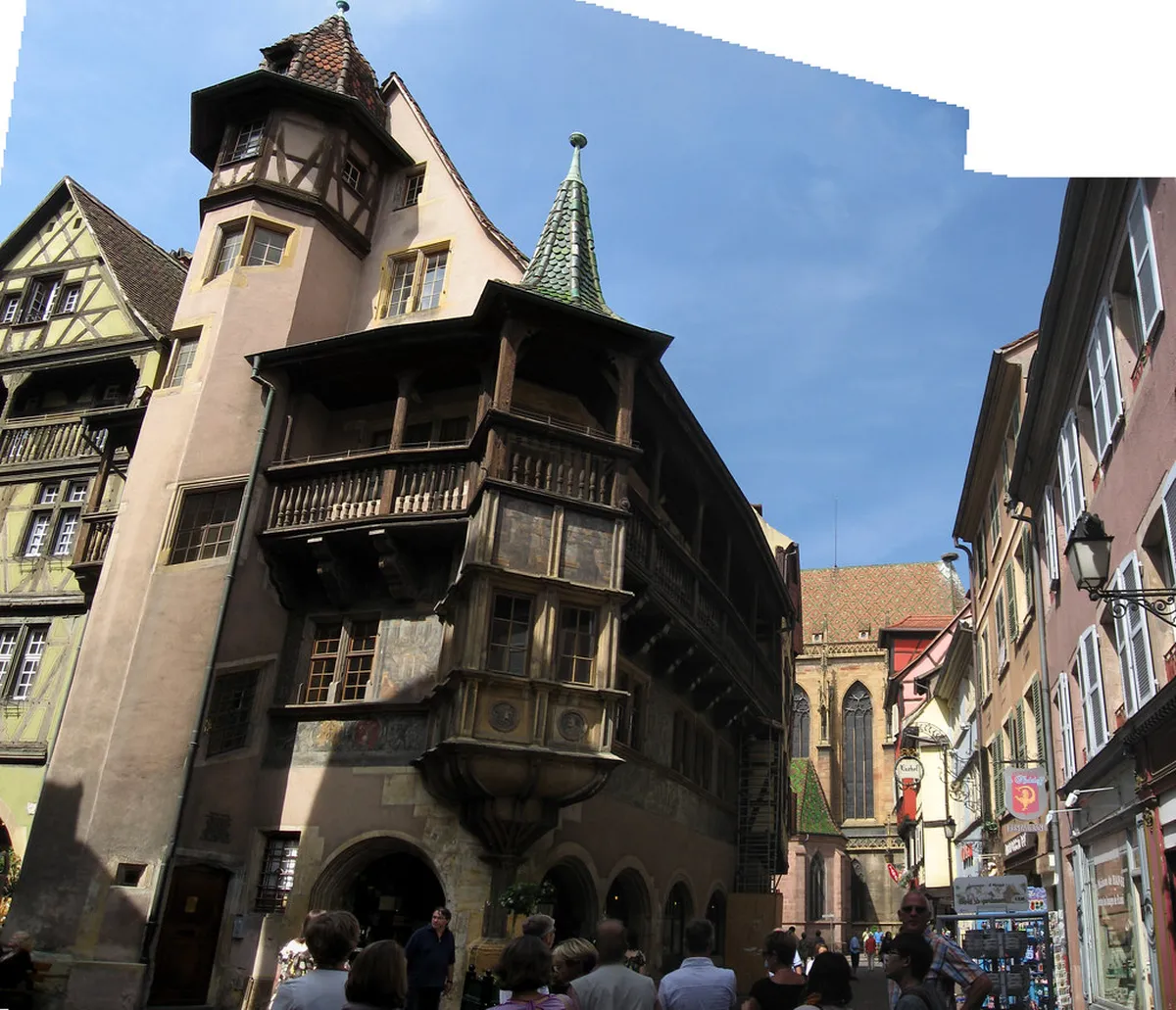
An octagonal turret is another one of the major Pfister House Colmar architectural details. This tower rises from the corner of the building and overlooks the street below. It features large windows that allowed the residents to watch the activity in the marketplace. The turret adds a sense of verticality and elegance to the overall stone structure.
Directly adjacent to the turret is a beautiful wooden gallery that wraps around the house. This balcony is crafted from dark wood and features delicate carvings along its railings. Such galleries were rare in Colmar during the 1500s because they were difficult to build. It serves as a perfect viewing platform for the upper floors of the residence.
The combination of stone and wood creates a wonderful contrast in textures and colors. The ground floor is solid stone to provide a strong foundation for the heavy levels above. The upper sections use timber framing to allow for more windows and decorative flexibility. This architectural style is typical of the transition from Gothic to Renaissance building methods.
You can capture great images of these features at the best photo spots Colmar has to offer. Stand across the street at the corner of Rue des Marchands for the best perspective. The morning light usually hits the wooden gallery and the turret perfectly for photography. Many artists sit in this spot to sketch the complex lines of the building.
Symbolism in the Renaissance Facade
The symbolism found within the Pfister House Colmar architectural details is deep and multifaceted. Every figure painted on the wall has a specific meaning related to virtue or power. For example, the figures of Faith and Justice are prominently displayed to the public. These symbols told the community that the owner was an honest and godly man.
The use of imperial imagery was a strategic move for a merchant like Ludwig Scherer. By showing the emperors, he aligned himself with the stability and order of the empire. This helped protect his business interests and raised his status among other wealthy local families. Architecture was a powerful tool for self-promotion in the sixteenth century city.
Even the animals depicted in the carvings and paintings have symbolic roles to play. Lions often represent strength and protection for the household living inside the stone walls. You may also spot smaller decorative motifs that represent abundance and prosperity throughout the facade. Every inch of the building was designed to send a message to the viewer.
The house is located near the Old Customs House, another symbol of Colmar's historic wealth. Both buildings show how architecture and commerce were closely linked in the medieval era. Merchants spent their fortunes to create a city that looked as rich as it felt. Pfister House remains the ultimate example of this competitive building spirit.
Comparing Pfister House to Other Colmar Landmarks
While Colmar has many timber-framed houses, the Pfister House is uniquely sophisticated in its design. Most other buildings in the old town rely on simple geometric patterns for their decoration. Pfister House uses figurative art and complex stone masonry to stand out from its neighbors. It is a transition piece that bridges two different eras of European history.
The House of Heads is another famous landmark nearby that features many carved faces. However, the Pfister House focuses more on narrative paintings and graceful wooden balconies instead. Both buildings demonstrate the incredible creativity of the Renaissance artists working in the Alsace region. You should visit both to see the variety of styles present in the city.
The ground floor of Pfister House features a series of elegant arches and sturdy columns. These elements show the influence of Italian design moving northward into the Germanic lands. Local builders adapted these southern ideas to fit the climate and materials available in France. The result is a hybrid style that is truly unique to this border region.
Today the building houses a small shop on the ground floor for tourists. You can buy local wine and souvenirs while standing inside a piece of history. The upper floors remain private and are not open for public tours in 2025. Still, viewing the exterior is one of the best free things to do in Colmar.
Visitor Guide for Colmar in 2025
Plan your visit to the Pfister House during the early morning hours to avoid crowds. The streets of Colmar can get very busy with tour groups by mid-day. Arriving at 8 AM allows you to see the architectural details without any distractions. You will also get the best light for your travel photos at this time.
The house is located at 11 Rue des Marchands in the historic center. This area is entirely pedestrianized so you must park your car outside the old town. Walking from the main train station takes about fifteen minutes through beautiful scenic streets. Most visitors spend about twenty minutes admiring the house before moving to the next landmark.
There is no entrance fee to view the exterior of this famous private home. You can simply walk up to the building and look at the murals for free. Consider bringing a pair of binoculars to see the details on the higher floors. Some of the best paintings are located near the top of the octagonal turret.
While in the area, check out the local bakeries for traditional Alsatian treats. The smell of fresh gingerbread often fills the streets near the Pfister House during the day. This creates a wonderful atmosphere that transports you back to the sixteenth century. It is a multi-sensory experience that makes Colmar such a popular destination for global travelers.
Frequently Asked Questions
Can you go inside the Pfister House in Colmar?
The upper floors of the Pfister House are private and not open to the general public. However, you can visit the ground floor which currently operates as a local wine shop. This allows you to see some of the interior stone arches and historic layout. Most visitors focus their attention on the incredible murals located on the exterior walls.
Who was the architect of the Pfister House?
The building was commissioned by Ludwig Scherer and built by skilled local craftsmen in 1537. While a single famous architect is not often named, it reflects the Rhenish Renaissance style. The murals are attributed to an artist named Christian Vacksterly according to some historical records. It represents a collective masterpiece of the sixteenth-century Alsatian building guilds.
What is the best time to photograph the Pfister House?
The best time for photography is early in the morning when the sun hits the facade. This usually occurs between 8 AM and 10 AM depending on the season. During this time, the light illuminates the wooden gallery and the detailed murals perfectly. You will also encounter fewer tourists blocking your shot during these early hours.
Where is the Pfister House located in Colmar?
You can find the Pfister House at 11 Rue des Marchands in the heart of the old town. It sits at the corner of a busy intersection near the Saint-Martin Collegiate Church. This location is central to most walking tours of the historic district. It is easily accessible on foot from any part of the city center.
Why is it called the Pfister House?
The house is named after the Pfister family who owned and restored the property in the 1800s. Although they did not build it, their restoration work was vital for its survival. Before their ownership, it was known by the name of the original builder, Ludwig Scherer. The Pfister name has remained the standard title for the building for over 150 years.
The Pfister House remains a crowning jewel of Renaissance architecture in the city of Colmar. Its stunning murals and unique wooden features tell a story of wealth and faith from 1537. Visiting this landmark allows you to step back in time and experience the grandeur of Alsace. Make sure to include this historic site on your next travel itinerary through France in 2025.
Key Takeaways
- Pfister House was built in 1537 and is a masterpiece of the Rhenish Renaissance.
- The exterior features biblical murals, imperial portraits, and a unique octagonal turret.
- The house is located at 11 Rue des Marchands in the pedestrian-friendly old town.
- Visitors should arrive early in the morning for the best lighting and fewer crowds.
Related reads: streetartly.com, street art and architecture in colmar, dominican church colmar architecture facts.